 ced15122d9
* Add one-shot app_config linter migration workflow

* Add app_config linter compatibility action

* Add add-on map compatibility normalizer

* Test add-on map compatibility normalizer

* Run app_config compatibility preparation on pull request

* Validate app_config short and long map forms separately

* Export validated workflow updates

* Use app_config-compatible linter for PR checks

* Use app_config-compatible linter for builds

* Remove temporary linter preparation workflow

* Add one-shot app_config manifest migration

* Migrate legacy addon_config maps to app_config

* Preserve upstream legacy aliases without deprecated literals

* Test legacy alias compatibility without deprecated literals

* Validate completed app_config migration

* Count only add-on manifests during migration validation

* Remove temporary migration validation workflow

* Document legacy alias construction

* Remove obsolete local linter compatibility script

* Remove obsolete local linter compatibility tests

* fix(pr-2937-review): address reviewer findings on app_config migration

- Remove the orphaned .github/actions/addon-linter composite action: it
  references .github/scripts/prepare_addon_lint_config.py, which was never
  added (the normalization approach was superseded by pinning
  frenck/action-addon-linter directly in #2936). Confirmed unused - no
  workflow invokes it.
- cleanuparr: HA_DATA_DIR pointed at /app_configs/cleanuparr, a path not
  mounted inside the container. cleanuparr's map is app_config:rw, which
  Supervisor mounts at /config, so data was living on the ephemeral
  container filesystem. Point it at /config instead (pre-existing bug,
  not introduced by this PR - just carried the wrong path forward).
- joplin/README.md: joplin's config.yaml still declares config:rw, not
  app_config (it was never part of the 86-manifest migration). Revert the
  doc text that incorrectly started calling it the app_config mapping.
- qbittorrent/00-folders.sh: fix a pre-existing copy/paste bug in the
  migration marker/log for the main-folder migration block - it referenced
  "openvpn" and a "qBitorrent" typo instead of qBittorrent.

Co-Authored-By: Claude Sonnet 5 <noreply@anthropic.com>

---------

Co-authored-by: github-actions[bot] <41898282+github-actions[bot]@users.noreply.github.com>
Co-authored-by: Claude Sonnet 5 <noreply@anthropic.com>
Co-authored-by: copilot-swe-agent[bot] <198982749+Copilot@users.noreply.github.com>
6.6 KiB
Home assistant add-on: Postgres
I maintain this and other Home Assistant add-ons in my free time: keeping up with upstream changes, HA changes, and testing on real hardware takes a lot of time (and some money). I use around 5-10 of my >110 addons so regularly I install test machines (and purchase some test services such as vpn) that I don't use myself to troubleshoot and improve the addons
If this add-on saves you time or makes your setup easier, I would be very grateful for your support!


Addon informations





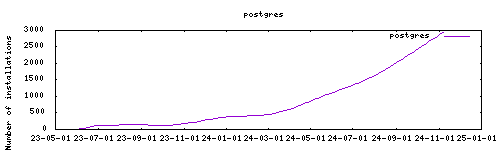
Thanks to everyone having starred my repo! To star it click on the image below, then it will be on top right. Thanks!

About
PostgreSQL, often simply "Postgres", is an object-relational database management system (ORDBMS) with an emphasis on extensibility and standards-compliance. As a database server, its primary function is to store data, securely and supporting best practices, and retrieve it later, as requested by other software applications, be it those on the same computer or those running on another computer across a network (including the Internet). It can handle workloads ranging from small single-machine applications to large Internet-facing applications with many concurrent users. Recent versions also provide replication of the database itself for security and scalability.
This addon is based on the official image : https://hub.docker.com/_/postgres
Configuration
Postgres port is by default 5432 and is exposed to the host network.
default user: postgres
password: set by POSTGRES_PASSWORD
You can configure this options:
POSTGRES_PASSWORD
POSTGRES_USER
POSTGRES_DB
POSTGRES_INITDB_ARGS
POSTGRES_HOST_AUTH_METHOD
For more info check base image docs.
By default postgresql.conf is stored in volume accessible by other addons and Home Assistant, so you can conviniently modify it by e.g. File Editor addon. If you prefer better security change CONFIG_LOCATION to e.g. /data/orig/postgresql.conf, so it will be acessible only to this addon, but you will have to modify it by the Hassio SSH.
Custom Scripts and Environment Variables
This addon supports custom scripts and environment variables through the app_config mapping:
- Custom scripts: See Running Custom Scripts in Addons
- env_vars option: Use the add-on
env_varsoption to pass extra environment variables (uppercase or lowercase names). See https://github.com/alexbelgium/hassio-addons/wiki/Add-Environment-variables-to-your-Addon-2 for details.
Installation
The installation of this add-on is pretty straightforward and not different in comparison to installing any other add-on.
- Add my add-ons repository to your home assistant instance (in supervisor addons store at top right, or click button below if you have configured my HA)

- Install this add-on.
- Click the
Savebutton to store your configuration. - Set the add-on options to your preferences, at least POSTGRES_PASSWORD is required.
- Start the add-on.
- Check the logs of the add-on to see if everything went well.
- Use any Postgres client to connect, e.g. to
homeassistant.local:5432
Migration from postgres 15 :
- stop the postgres 15 addon
- use the Filebrowser addon to copy the database folder from /app_configs/xxx-postgres to /app_configs/xxx-postgres_latest
- start the postgres 17 addon. Upgrade of the database should proceed. In case it doesn't, your data is anyway safe in the postgres 15 addon
Security
By default, Postgres will be reachable on the local network of your host system. To improve security, you can disable this behavior and make Postgres available only to other Add-ons within Home Assistant.
- Configure all Add-ons that use Postgres to connect via the internal DNS name:
db21ed7f-postgres-latest:5432. - Go to Settings → Add-ons → Postgres 17 → Configuration, and under Network, remove port
5432by clearing the text field. - Click Save and restart the Add-on.
- Postgres is now only accessible from other Add-ons and no longer reachable from your local network (e.g., laptop, IoT devices, etc.).
Support
Create an issue on github